


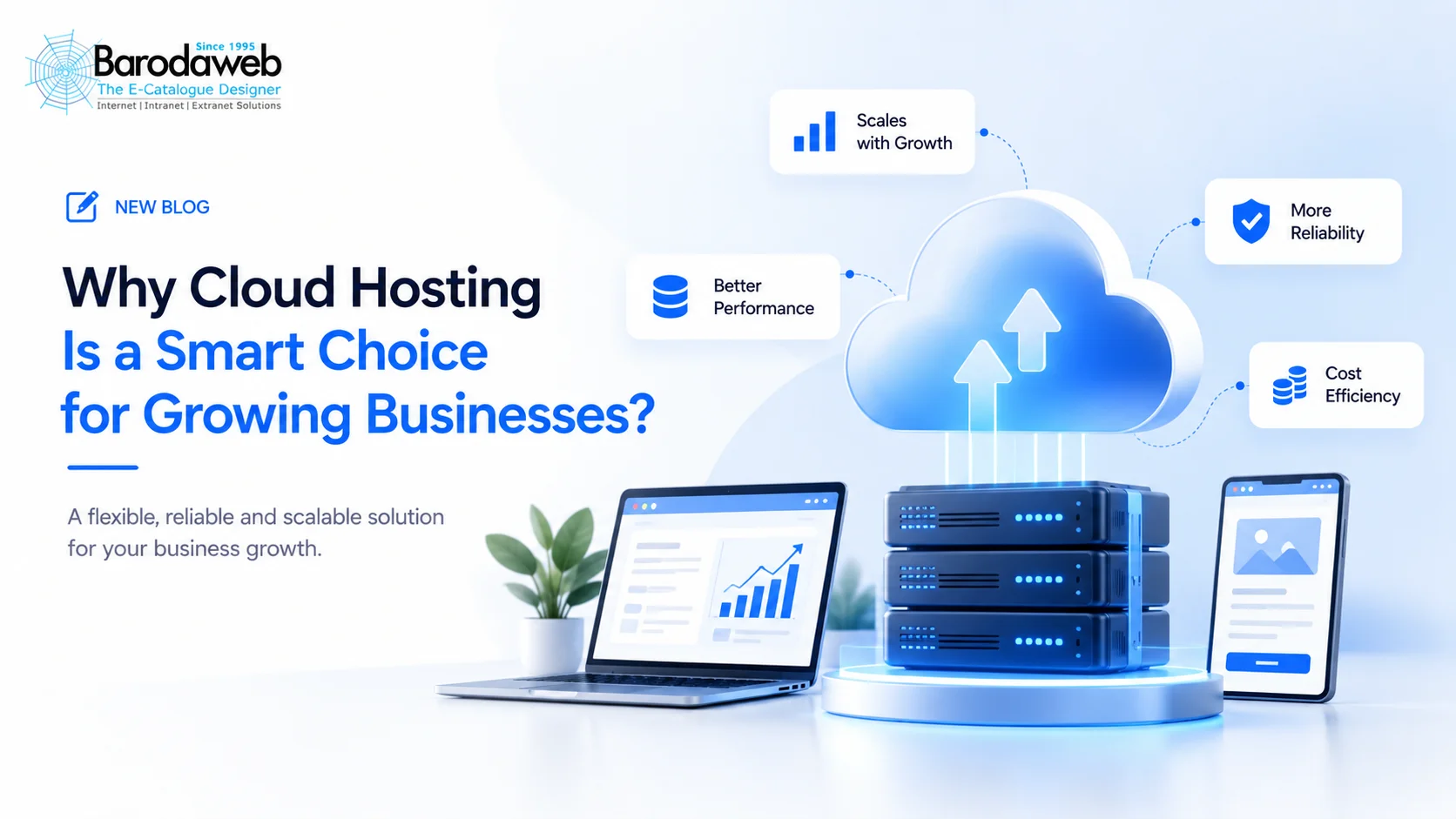
25 September 2026 | Admin
Most business websites start small, and that's fine. A few visitors a day, a couple of enquiries, nothing that pushes the setup anywhere near its limits. Then things pick up. More customers show up, someone decides the site needs an application bolted on, or one campaign does better than anyone planned for and traffic spikes overnight. Suddenly hosting isn't background noise anymore — it's a decision that actually matters.
And the real question was never "where does my website live?" It's "can this setup keep up with me?" That's basically the whole pitch behind Cloud Hosting for businesses that are actually growing, not just hoping to.
What Makes Cloud Hosting Different?
Traditional hosting usually hands you a fixed chunk of resources — so much storage, so much processing power — and that's it, that's what you get. Fine if your traffic looks the same every month. Not so fine if it doesn't.
And for a growing business, it usually doesn't. Traffic climbs and dips. An app might need a burst of extra muscle during a launch week and then barely touch it the week after. A site that felt roomy on day one can start to feel tight the moment the business actually takes off.
That's where Cloud Hosting Services work differently. Resources stretch or shrink based on what's actually going on, instead of sitting frozen at a number someone guessed at months ago. Hosting stops being a one-time decision you make and forget, and starts being something that keeps pace with the business.
Why Are More Businesses Moving to Cloud Hosting?
Resources Can Scale With Demand
Ask around, and flexibility is usually the first reason companies mention when they start looking at Cloud Hosting For Business. Makes sense — a growing website doesn't need the same amount of muscle behind it every single day.
Say an online service ticks along quietly most of the month, then gets hit with a flood of visitors the week a campaign goes live. Being able to pull in extra resources just for that stretch, then dial it back down afterward, isn't a fancy extra. It's just practical.
Better Control Over Hosting Costs
Let's be honest about cost, because it's easy to oversell this part: cloud hosting won't automatically be cheaper. It depends on your setup. What it does give you, going by how Barodaweb has structured its Cloud Hosting plans, is usage-based, hourly billing — so what you pay lines up with what you're actually using instead of paying for capacity that just sits there doing nothing.
Less Dependence on a Single Physical Server
Then there's the server question. A lot of traditional hosting ties you to one shared physical machine alongside a pile of other websites you have no control over. Cloud hosting doesn't work that way — your resources aren't hostage to whatever else is happening on that box, so you get an environment built around what you actually need.
If a business relies heavily on its website or a customer-facing app, that kind of separation isn't a minor technical footnote. It's the difference between sleeping fine and checking the site at 2am.
What Are the Benefits of Cloud Hosting for Businesses?
The Benefits Of Cloud Hosting For Businesses aren't just about surviving a traffic spike. It's really about being ready — for whatever's coming next, rather than scrambling once it's already arrived.
Maybe there's a new service launching. Maybe an application is being added, or a campaign is about to go out and nobody's quite sure how big the response will be. A hosting setup that can flex means the business gets to plan for these moments instead of constantly wondering whether the current setup can take the hit.
There's a cost angle here too, for what it's worth — nobody wants to pay for a pile of unused capacity just because it might come in handy someday.
When Should a Business Consider Cloud Hosting?
There's no threshold — no magic number of visitors where a bell rings and it's suddenly time to switch. It really comes down to the site itself, what's running on it, how traffic behaves, and where things are headed.
That said, if resource needs keep shifting around, if new online services keep getting added, or if the business is clearly on a growth trajectory, it's worth taking a proper look at the current hosting setup. Better to check before it turns into a bottleneck than after.
The real question isn't where the business is right now. It's where it's actually going.
Choosing Cloud Hosting Services In Vadodara
If you're hunting for Cloud Hosting Services In Vadodara, the provider matters just as much as the tech behind it — arguably more.
Don't just glance at the package and move on. Look at how resources are actually managed, what support looks like day-to-day, how the pricing plays out in practice, and whether there's someone to call when something breaks. Because something eventually breaks.
Nobody running a business should need a computer science degree just to keep their site online.
Why Hosting Support Still Matters?
Good hosting only gets you halfway there. The other half is support — because websites and applications need updates, maintenance, and someone on the other end of the line when things need fixing.
Barodaweb bundles cloud hosting together with web development and support work, including ongoing website and application maintenance. For a business weighing up Business Cloud Hosting, having that kind of support built in tends to make the whole thing a lot less stressful.
At the end of the day, hosting exists to make running a business easier, not to become one more thing on the to-do list. As the business grows and changes, a flexible hosting setup gives it room to breathe — without turning the owner into an unpaid IT department.